Location-aware OpenGov & Crowdsourced Data

I’ve been reading a lot about OpenStreetMap because, for many reasons, travel is something that I’m intending to do a lot more of. Using your Maps app on your SmartPhone when in a foreign country is just a license for your carrier to print money. When you consider the amount of data transmitted it’s evident … Continue reading “Location-aware OpenGov & Crowdsourced Data”

I’ve been reading a lot about OpenStreetMap because, for many reasons, travel is something that I’m intending to do a lot more of.

Using your Maps app on your SmartPhone when in a foreign country is just a license for your carrier to print money. When you consider the amount of data transmitted it’s evident that until roaming costs are brought under control. there’s no sense in using online maps when travelling. Which kinda defeats the purpose.

So, OpenStreetMap, if you download the maps (something that you cannot do with Google Maps) seems to be a much more sensible proposition especially now that storage on SmartPhones is getting to the point that this becomes practical.

So, is a map enough?

Of course it is. But where things become interesting is when you combine them with other sources of data. Such as the newly opened data we’re getting out of OpenDataNI or some of the data which is available from NISRA (though the latter seems all embedded in PDF and not raw data at all).

This sort of ‘real life’ data is of immense interest, if people realise they can ask for it.

What about a location-aware app that:

  • stays open and records one set of location data every minute. What’s the interest there? It tells you where the fast and slow bits of the roads system are. Collate this data with a hundred other users across the province (never mind any other country) and you’ll generate an instant map of where the traffic snarl-ups are. Make it so that you can shift through the data according to time of day and you’ve got the basics of a route planner that will help you see traffic trends ahead. That’s much more useful than having someone sit and count cars all day at a junction.
  • stays open and records any bumps and jolts in the roads system using the built in accelerometer that comes with every new SmartPhone. Built in a threshold value and send any data that exceeds this up to the server. You’ll have to take into account the driver hitting the kerb or the iPhone dropping out of it’s holder but those should be outlying data points – what you’ll get is a bump map (or more accurately, a pothole map) of the province. So you can either avoid those roads or ask your local politician why this has gotten so bad and not been fixed.
  • permits the average citizen to report civil issues such as vandalism, broken kerbstones, potholes, non-functional streetmaps, illegal dumping or other civic issues. They take a photo, maybe add an audio report or text tag and the data is sent up to a server. Combine them into a map and look for which councils have the most issues. Offer the data to the councils to help them find the issues that plague them. Keep a report open on which councils respond better.
  • listens for keywords that a driver may shout. And we can see which parts of the road and which times of the day frustrate the most drivers. Yes, it’s a simplistic measure of Road Rage but a relatively cathartic one. Maybe the DoE Roads Service can focus on those areas with the most reports and see what they can do to alleviate it. It’s not always going to be other drivers.
  • gives you some advance warning of roadworks? There must be a database of this somewhere within the Roads Service – the question is how to get that data. And have the app do it’s own reporting so we can crowdsource what data we can’t get from official sources. I’d certainly be interested in seeing the difference between reported roadworks and planned roadworks – I’d expect there to be none?
  • tells you where the nearest taxi is and gives you an indication of it’s availability. All Taxi companies install GPS units in their taxis – we just want to know who is available and close so we can get a taxi quick. On the taxi front, why is there not an easy lookup for the new Taxi plates so we can type in the taxi number (or God forbid, photograph it) and be quickly given back the Registration plate it belongs to along with a photo of the taxi driver meant to be driving it.
    Green Taxi Plate

    That would give me heaps more confidence in the system. I don’t want to know his name, how many kids he has or whether he’s got a Microbiology degree – I just want to know if he’s who he says he is. Anyone can stick up a coloured plate.
  • tells you where your nearest bus stop is and tells you where the next bus to that stop is, where it’s going and it’s estimated time of arrival. Every bus has a GPS sender in it so we know the data is available. And we’d need access to the timetables as well. It would mean having useful data on when we’d need to leave the office to get a certain bus whether that bus is delayed or whether we should run for the train instead. Whether or not this be expanded to include reporting of cleanliness or vandalism or even just reporting exactly how late the bus was is up for debate.
  • gives you the approximate location of the flight your gran is on so you can choose not to wait in the expensive car park and go have a coffee somewhere that doesn’t cost an arm and a leg. Tie that in with the flights timetables and we’re laughing. (Today we were picking a friend up from Belfast City Airport. And the flight was diverted to the International. BCA did not know. It landed safely. BCA did not know. In fact, they had no information at all on what it was doing.)
  • shows you examples of urban archaeology. There are thousands of pictures out there showing what the city looked like ten years ago, fifty years ago, a hundred years ago. Why not use a street map to provide a ‘historical Street View’ so we can see what buildings used to look like, what traffic used to pass here and view landmarks which have long since disappeared.
  • provides a glimpse into the future. I think there’s real potential for architects and city planners to get out of their micro-models and into the real world and use these devices to help visualise what buildings will look like in situ. I’d reckon if that had been done down near the Waterfront, we’d not see the Waterfront hidden by architecture that comes from the breeze block era. It’s a beautiful building. Surrounded by horrors.
    image.aspx
  • shows you all of the tourism events happening today in a visual form. Drag a slider or swipe over to 11 am and see what’s on where. Drag again to 2:30 and see what’s going on there. Community groups and Tourism agencies should be all over this.

The information context we need on all of this is location and time. Without both of these, there’s not enough context to make them truly useful.

We’d need everyone in every country to be using apps like this so there’s definitely an Export potential and a method of getting the information in there. These sorts of apps would be incredibly suitable for the “Mobile Apps Challenge” that is being organised by Digital Circle and Momentum, details of which will be forthcoming once sponsors are confirmed.

All of this becomes extremely exciting when you start looking at the apps which are driving AR to the top of the Hype Curve but even without AR, this is useful stuff.

The Cocoa Cooking Class

This came out of two ideas I had. The first was Code4Pizza – the idea that people, in order to learn, would be willing to spend their time coding for open source projects. I still think this idea is a winner for getting younger folk involved but as an evening class, it fills in many … Continue reading “The Cocoa Cooking Class”

This came out of two ideas I had.

The first was Code4Pizza – the idea that people, in order to learn, would be willing to spend their time coding for open source projects. I still think this idea is a winner for getting younger folk involved but as an evening class, it fills in many gaps present in the current market for young and really smart folk who want to use computers for more than FaceBook and MySpace.

The second was Tuesday Night Cocoa – something the lads up at Mac-Sys were doing – on a Tuesday evening when the Enterprise Park was open late, they would gang together and learn Cocoa from the books, helping each other through tough problems.

So, the Cocoa Cooking Class was born.

First off, I’m not even sure if Tuesday night is the best sort of time for something like this but it’s catchy, sosumi.

The Background:
Due to my organising of DevDays and generally being loud about the iPhone, I’m inundated with people wanting to learn how to do stuff on the iPhone. How to write applications and generally take part in the gold rush that is the iPhone. I’m working my way through the books but as my time is ‘expensive’ (in so far as as it’s really bloody hard to find ‘free’ time), I’m thinking I need to formalise something in this respect. My idea is that an experienced developer guides a workgroup on a weekly or biweekly basis through an application specification, design and build. The workgroup then owns that app and can do whatever they want with it. I’ve spoken to an experienced developer about it and he’s on board, details yet to be discussed. It’s unreasonable to expect him to dedicate this time for free so we have to take that into account and allow for him to help people ‘online’ in a forum or via email. Holding it on a Tuesday night might make sense but the idea is to get someone who knows what they’re talking about to come in and spend time instructing people and get paid to do it. If it’s not worth the money then we stop paying them and we hack it together on our own time. We even have the option of varying our instructors.

The Pitch:
Take one room with enough seating for 11 people.
Fill with 10 or so eager would-be application developers. Do not over-fill.
Add in one seasoned instructor. Mix for twenty minutes.
Establish base level of capability and break the people into 3-5 groups.
Distribute skills liberally through the groups to attempt to maintain consistency.
Start to build projects, one for each group for 90 minutes.
Break for 15 minutes to check consistency and share experiences.
Return to the room and continue to build knowledge for a further hour.
Stop activity and get each workgroup to show and tell for 5 minutes each.
Rinse and repeat weekly or bi-weekly.

To cover costs, everyone hands the instructor a £20 note. This covers room hire, instructor time and during the week support. That’s a reasonable night out.

Reasoning:
It’s my belief that this will create multiple opportunities for Mac and iPhone developers in the province. It will provide a collaborative approach to building applications with some real potential for IP creation and future revenue generation. Mix this with XCake and other initatives and we’ve got something to talk about. Would be even better if we could get some sort of funding for it (or even just a free room somewhere for the evenings).

What do you think?

YCombinator receives additional funding

TechCrunch reports that Ycombinator, the really-early-seed-capital guys, have received some additional funding ($2 million) from Sequoia. Ycombinator only invests small amounts ($5,000 + $5,000/founder) in exchange for around 6% of equity and has invested in around 118 startups since their foundation in 2005. Some of their startups have been acquired (Reddit, Omnisio, Zenter, ClickPass, Auctomatic) … Continue reading “YCombinator receives additional funding”

TechCrunch reports that Ycombinator, the really-early-seed-capital guys, have received some additional funding ($2 million) from Sequoia.

Ycombinator only invests small amounts ($5,000 + $5,000/founder) in exchange for around 6% of equity and has invested in around 118 startups since their foundation in 2005. Some of their startups have been acquired (Reddit, Omnisio, Zenter, ClickPass, Auctomatic) and others are doing well (Scribd, Loopt, Dropbox).

It’s obviously not just about the money which probably provides a conservative 2-3 months of free development time – they get mentoring and polish from the Ycombinator principals who had previously invested all their own money – and are honed to pitch at later stage VCs and angel investors.

I was saying recently that development time for ideas really depends on the amount of time the creators can dedicate to it and the initial idea that you might get 3 months sold work into something can work wonders. This is one of the funding gaps we have – we have very little in this really early stage where you can make a huge difference with minimal outlay.

This additional funding from Sequoia means that YCombinator will be able to leverage a better cash flow and increase the number of investments from 40 per year to 60 per year – which should see them secure for another couple of years. Spreading the investment like that is the safest way to invest – as it only takes one success to make up for a large number of duds. That’s not to say that startups who don’t make it big through YCombinator are duds – it’s just one more piece of the puzzle.

I spoke with a friend recently about what I’d do if I had £100K to invest – I’d pretty much do a YCombinator style investment plan. We have the entrepreneurs, techies and dreamers here in Northern Ireland. We just don’t have the funding.

XCake 1st Meetup

After several months of talking about it, we’ve had our first XCake meetup. We had 20 people turn up, all told. They ranged from the education sector (Belfast Met, The University of Ulster and Queen’s University of Belfast) to the private sector (sole traders, bedroom developers, partnerships and limited companies) including some companies which have … Continue reading “XCake 1st Meetup”

After several months of talking about it, we’ve had our first XCake meetup.

img_0043

We had 20 people turn up, all told. They ranged from the education sector (Belfast Met, The University of Ulster and Queen’s University of Belfast) to the private sector (sole traders, bedroom developers, partnerships and limited companies) including some companies which have a distinguished history of software development.

Philip Orr’s Home of Serendipity has another XCake writeup.

It’s to be followed next Tuesday (24th) by an XCake meetup in Dublin.

Tuesday Night Cocoa

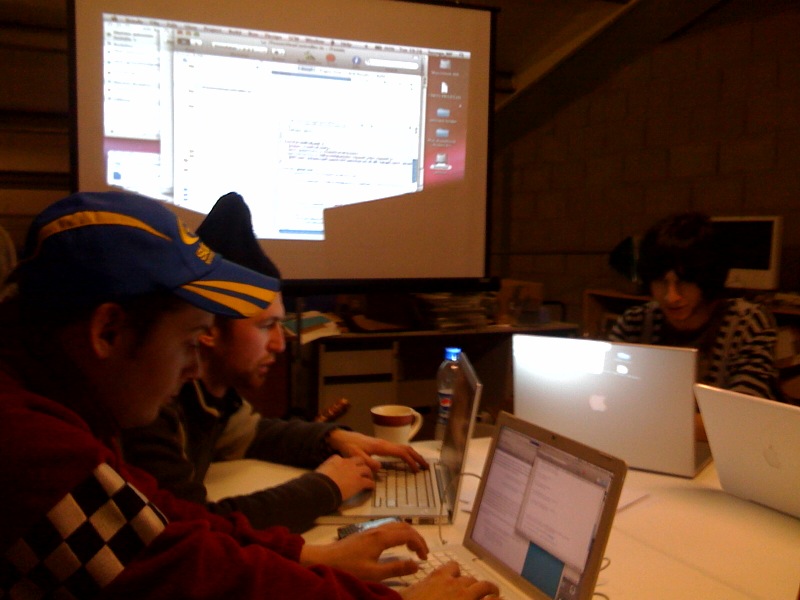
  Tonight was the Tuesday Night Cocoa group meet. Half a dozen hairy blokes sitting in the Mac-Sys Ltd offices with instructional PDFs up on a projector and open books in front of them. I’m very keen on this – this is a small cadre of fellahs, some of whom work in Mac-Sys and some … Continue reading “Tuesday Night Cocoa”

photo   Tonight was the Tuesday Night Cocoa group meet. Half a dozen hairy blokes sitting in the Mac-Sys Ltd offices with instructional PDFs up on a projector and open books in front of them. I’m very keen on this – this is a small cadre of fellahs, some of whom work in Mac-Sys and some of whom don’t, taking the time of an evening to fix issues with their coding projects and leaving with homework which they’ll work on during the week. To a degree I’m envious but I’mr eally glad I was able to help them get this started.

None of the guys there had any coding experience and yet they’re tackling the iPhone SDK in their spare time. They’ve buzzed me a couple of times in the last week or so with compile errors which they couldn’t debug (simply due to their lack of experience) but tonight they didn’t need to ask once – the previous nights and afternoons they have put into this have started to pay off.

It’s a great example of grassroots doing it for themselves – this is what I love about the current industry – people doing it without asking permission – whether they’re running a code class for the iPhone, running a coffee meetup for tech-heads just because they’re in the right place and the right time or knocking brains together to create a mashup of two useful services – it’s great.

Kudos to them and I can’t wait to see what they’re working on next.

Make Corporate Butts Pucker

I wrote: A year ago Rich Segal wrote an article on how to make a corporate butt pucker. As we inch closer to opening the CoWorking site in Belfast, I find myself having loftier dreams regarding it. I envisage a place where we can assist startups and if necessary turn a couple of dreamers into … Continue reading “Make Corporate Butts Pucker”

I wrote:

A year ago Rich Segal wrote an article on how to make a corporate butt pucker.

As we inch closer to opening the CoWorking site in Belfast, I find myself having loftier dreams regarding it. I envisage a place where we can assist startups and if necessary turn a couple of dreamers into new entrepreneurs.

The level of support required for this would, of course, be minimal.

What does ‘Code4Pizza’ get out of it?

Well, the aim is kudos and ten percent. Ten percent? Yes, ten percent of the company created. Which means the directors of code4pizza are motivated to make it a success. It will be the only way that code4pizza can become self-sustainable.

What do students get out of it?

A real placement? How about a placement where they’re not washing the VP’s car (as happened in Nortel). Or making tea for line managers in manufacturing (again, Nortel). They’ll get real experience, real mentoring from real business people who are highly motivated to turn them into a success. And at the end they’ll hold 90% of a company they helped build.

So…

I’ve not yet tested the viability in terms of putting it in practise. I’ve spoken to lecturers and they think it’s a great idea. I’ve spoken to entrepreneurs and they love it too. I’ve even spoken to a few students about it and they’re convinced it would take off. So everyone loves it, now what.

  1. CoWorking Belfast
  2. Collaborative Contracts
  3. Initial Funding
  4. Programme Development

Okay….

…why will this make corporate butts pucker?

The idea is that a simple, lean company with three founders and one good mentor can kick butt.

Crazy? I don’t think so.