Apple Creator Studio announced.

Apple has just announced Apple Creator Studio, a new subscription suite that bundles together its professional creative apps — including Final Cut Pro, Logic Pro, Pixelmator Pro, Motion, Compressor, and MainStage — into one affordable package. It also adds premium content and AI-enhanced features to productivity apps like Keynote, Pages, Numbers, and soon Freeform, making creative workflows smoother across Mac, iPad, and iPhone.

The service launches on January 28, 2026 for $12.99/month or $129/year (with discounted student/educator pricing), and offers a one-month free trial. Subscribers can tap into powerful tools for video editing, music production, image design, and more — all while still having the option to buy apps individually if preferred.

So, what it really means is that if you want to use the Pro apps, it’s a pretty cheap subscription. If you want to use the Free apps, you can continue to do so. If you want to get the stock art and intelligent features, join the subscription. I think I’d need to see the Premium features first before adding any more.

I’m a pretty heavy user of Pages and have a couple of subscriptions to stock art services.

Meshtastic Malta

Following a post on r/ossmalta on Meshtastic, I decided to invest in a couple of radios and see what was out there. I also left it turned on while I travelled to Warsaw over Xmas and saw what I could see. OSSMalta has a page about their ambitions (slow link).

Huge amounts of activity around Austria

But back here in Malta, it’s a little more quiet.

Though I have noticed a little more activity in the evenings.

Back twenty years ago I was wandering around Titanic Quarter in Belfast with a Omni and a Backfire antenna attached to WiFi cards marvelling at transmitting IP pings over a mile. Some of you might remember that.

Now, There’s definitely a case for the utility of building a Mesh network where you are. One might be out of band management (this is a post about a secure shell over Meshtastic) and this one describes the utility during the Iberian Power Outage and the ongoing invasion in Ukraine.

Meshtastic as an out-of-band, resilient communications network would seem to be a no-brainer.

Response to Texanarob on Public Transport.

It would take you thirty seconds to find this shit out with your AI of choice but, Jesus Christ, you’re getting bodied in the comments already.

So, here you are. Loads of research you won’t read because you’ve “done your own research” – note that having an opinion isn’t quite the same. As I mentioned I went to the Minister with a folder full of this shit ten years ago. I didn’t turn up with a stupid grin and a tree hugger badge. Massive savings to the economy directly, massive savings due to the improved health-related outcomes and, on top of that, if you take things like bus lanes and cycle lanes actually seriously it reduces congestion. The ALTERNATIVE (the one proposed by the Roads Service in Northern Ireland) is BUILD MORE ROADS – which is what happens when you stick 600 road engineers in a building and ask them for solutions.

Most objections to PT improvements tend to come from people who don’t really want the poors to get benefits. But even Phony Stark thinks mass transit is a smart idea (as he reinvents trains and buses for the techbros)

With the burden of proof on my side resolved, you can see why I’m supporting these moves. When your mum is driving you to your next appointment, she would have less traffic.
But here we are. Examples of how public transport did all of the things I said – and not just congestion. Nice of them to keep researching it to provide up to date data.

Public transport & traffic congestion / traffic flow
Anderson, 2014 – Los Angeles transit strike “natural experiment”
Reference: Anderson, M. L. (2014). Subways, Strikes, and Slowdowns: The Impacts of Public Transit on Traffic Congestion. American Economic Review, 104(9), 2763-2796.
What it does: Uses a multi-week LA transit strike as a shock and measures what happens to congestion when transit is removed.
Key findings: The strike increased peak-period delays by about 47%, implying that operating LA’s transit system reduces traffic delays by billions of dollars per year.

Beaudoin, Farzin & Lin Lawell, 2015 – Literature review on transit & congestion
Reference: Beaudoin, J., Farzin, Y. H., & Lin Lawell, C.-Y. C. (2015). Public transit investment and traffic congestion: A systematic review of the empirical literature. Transport Policy / Transportation Research family. 
ScienceDirect
Key findings: Reviews empirical work on how transit investment affects congestion and air quality. Concludes that PT can reduce congestion, especially in dense cities and congested corridors, but effects are context-dependent (land use, road pricing, etc.).

Beaudoin & Lin Lawell, 2016+ – Theory & empirical work on congestion relief
Reference: Beaudoin, J., & Lin Lawell, C.-Y. C. (2016). The effects of public transit investment on congestion, auto travel demand and air quality. In The Economics of Transport (chapter). 
clinlawell.dyson.cornell.edu
Key findings: Shows that transit investment can reduce car travel and improve air quality; congestion relief is significant where transit is competitive in time/cost and road networks are already saturated.

Monetary valuation of congestion relief from PT
Reference: Comparative review of “Evaluating the Congestion Relief Impacts of Public Transport in Monetary Terms” (2025 working paper / review). 
ResearchGate
Key findings: Summarises international evidence that PT absorbs peak-hour demand, increases overall network capacity and reduces congestion, and converts these effects into monetary values for cost-benefit analysis.

Tallinn, Estonia – the classic free PT case
Cats, Reimal & Susilo, 2014 – Before/after evaluation
Reference: Cats, O., Reimal, T., & Susilo, Y. (2014). Evaluating the Impacts of Fare-Free Public Transport Policy: The Case of Tallinn, Estonia. Transportation Research Record, 2415, 89-96. 
repository.tudelft.nl
Key findings:
Fare-free PT increased boardings, especially in lower-income districts (upwards of ~10% in some areas).
It improved mobility for unemployed and low-income residents.

Chen, 2014 – Mode choice under Tallinn’s free PT policy
Reference: Chen, X. (2014). How the free public transport policy influences public transport mode choice: The case of Tallinn, Estonia (Master’s thesis).
DIVA Portal
Key findings: Fare-free policy changed perceptions of PT and increased its use, but price alone was not enough to induce large numbers of drivers to switch without parallel measures (parking, service quality, etc.).

Dunkirk (Dunkerque), France – free buses + network upgrade
Urban Mobility Observatory / French studies
Reference: EU Urban Mobility Observatory. (2019). Free public transport in Dunkirk, one year later. 
EU Urban Mobility Observatory
Key findings:
After introducing free bus travel and redesigning the network (September 2018), bus ridership increased by 65% on weekdays and 125% on weekends.
A follow-up study reported a “significant contribution” to reducing private car use; about half of new bus users previously drove for the same trips.
Local evaluation & surveys

Reference: Observatoire des villes du transport gratuit – Dunkirk study on young people & mobility. 
obs-transport-gratuit.fr
cbwmagazine.com
Key findings:
Many respondents reported using the bus instead of a car; a small but non-trivial share sold a car or avoided buying a second car.
Reported benefits: better access to jobs and social activities, reduced transport costs, perceived improvement in air quality and urban environment.

Germany’s 9-Euro Ticket – deep discount nationwide
Klotz et al., 2024 – Highway traffic response
Reference: Klotz, P. A., et al. (2024). The Impact of Public Transport Subsidies on Highway Traffic: Evidence from Germany. Working paper. 
EconStor
Key findings:
The temporary 9-Euro Ticket (summer 2022) led to a more than 18% decrease in highway passenger traffic in Germany during the policy period.
Public transport demand increased by ~44%, with survey evidence of some substitution from car to PT and reduced particulate pollution.
Effects on car traffic were significant but mostly temporary, fading when the ultra-cheap fare ended.

UITP, 2020 – “Full Free Fare Public Transport” policy brief
Reference: UITP (International Association of Public Transport). (2020). Full Free Fare Public Transport (Policy Brief). 
UITP
Key findings:
Across multiple free-fare cities, ridership tends to rise substantially.
However, reductions in car use are “quite limited” in many cases; a lot of the extra PT use comes from walking/cycling and induced trips.
Where there is modal shift from car, potential benefits include improved local air quality, road safety and noise reduction, but capacity and funding constraints can offset some gains.

Wider co-benefits (health, emissions, equity)
Built environment, active travel & PT – health + congestion co-benefits
Reference: Smith, M., et al. (2017). Systematic review of built environment effects on physical activity and active travel. Health & Place, 43, 287–299. 
PMC
Key findings: Replacing motorised trips with active modes and PT reduces congestion and emissions while improving physical activity and public health.
Low-carbon transport in cities – air quality & health
Reference: International Transport Forum / OECD. (2025). Health Impacts of Low-Carbon Transport in Cities: Evidence for Decision-Making. 
ITF OECD
Key findings:
Shifting from private cars to PT, walking and cycling cuts greenhouse gases and improves air quality.
Associated reductions in premature deaths and chronic disease make PT expansion highly cost-effective.

Fare-free PT & social inclusion
Reference: Štraub, D. (2025). Re-examining fare-free public transport for greater inclusivity: Evidence from Brazil’s student fare-free law. Case Studies on Transport Policy. 
ScienceDirect
Key findings: Shows how fare-free schemes for low-income students improve educational access and social inclusion, illustrating non-traffic benefits of free PT.

I want to try Huawei

Honestly, after being a Mac guy since around 1994, I’m a little tired of Apple.

Let me clarify that from the start: this isn’t about hating their products. I still love my iPad—nothing else matches its blend of fluidity, tactile control, and elegant software. It’s a pleasure to use, whether I’m sketching, note-taking, or simply reading in bed. My Mac remains one of the best machines I’ve ever owned: a workhorse with grace, a tool that’s as intuitive as it is powerful. Even the iPhone, for all its lock-ins and limitations, still offers the most polished mobile experience out there. I don’t have a problem with Apple’s devices. And I’m neck-deep in Apple’s ecosystem; I love my Ted Lasso and I have literally thousands of dollars spent on movies which are exclusively on Apple’s platform.

What I’m tired of is the company behind them.

Apple, the corporation, used to stand for something. At least, that’s how it felt. For those of us who joined the Apple ecosystem in the ’90s and early 2000s, it wasn’t just a brand—it was a declaration of values. Apple represented creativity, individuality, a kind of noble rebellion against the gray corporate blandness of the Microsoft era. Owning a Mac wasn’t just about specs; it was about choosing design over drudgery, elegance over conformity, and human-centric computing over corporate compromise. That’s what made us stick around. That’s what made Apple different.

But somewhere along the way—somewhere between record-breaking quarterly earnings, trillion-dollar valuations, and executive reshuffling—Apple lost something. Maybe it’s inevitable for any company that becomes a global behemoth. Success has a way of blunting ideals, especially when those ideals get in the way of shareholder value. How can you tell the most successful company in the world that they’re doing something wrong? And now, as I sit with the newest Apple devices in front of me, I find myself wondering: what exactly am I supporting when I keep buying into this

Because let’s talk about support. Apple used to be legendary for customer care. If something broke, you booked a Genius Bar appointment or go to an Apple Service Provider. You walked into a space that felt helpful, human, even joyful. You’d meet someone who knew the product, who’d listen to your problem, and who’d often go out of their way to fix it—even if the warranty had expired. You felt like you were dealing with a company that cared, not just about your business, but about your experience.

Today? Support feels transactional at best, outright obstructive at worst. Try calling AppleCare and you’ll get funneled through a maze of automated prompts before being connected to someone reading from a script. Go to a store and you’ll be lucky if your appointment isn’t delayed, rushed, or redirected. Genius Bars are crowded, understaffed, and strangely corporate now. That sense of goodwill—the sense that Apple had your back—has eroded. Replaced by policies, queues, and thin smiles. They’ve even dismantled the Apple Service Provider network – just pissing decades of goodwill down the drain.

Then there’s strategy. Apple’s strategy used to be visionary. They weren’t chasing market share; they were setting the agenda. Think of the iMac’s bold design, the iPod’s intuitive wheel, the iPhone’s touchscreen revolution, or the MacBook Air being pulled from a manila envelope. These were bold, clean statements. Apple took risks, often standing firm against trends that diluted user experience. No bloatware, no cheap compromises, no fragmented ecosystems.

But in recent years, Apple’s strategy has felt more like a hedge fund’s playbook. Services are the new goldmine, and everything is being bent toward recurring revenue. Apple One bundles, iCloud+ upsells, app tracking ads (which somehow aren’t tracking because they’re from Apple)—it all feels like death by a thousand microtransactions. Instead of delighting users, Apple is increasingly nudging them, corralling them, and subtly extracting just a bit more every month.

And what about the App Store? Apple’s “walled garden” once protected users from malware and delivered a curated, high-quality experience. Now, it feels like a toll road. Developers pay 30% to be there. Users pay more because developers have to factor in that cut. Rules are inconsistently enforced. Competing apps are throttled or shadowbanned. And heaven forbid you try to direct your users to an external payment page—that’ll get you flagged, penalized, or booted. The garden has grown thorns, and they’re facing inward.

Apple has gone to court defending this ecosystem, claiming it keeps users safe. But let’s be real: it keeps Apple wealthy. What once felt like thoughtful curation now feels like gatekeeping. Monopolistic behavior dressed up in brushed metal. Apple should have been taking the lead in opening up the AppStore rather than having to have compliance forced upon them. They used to be the thought leaders here. Ironically, opening up and reducing fees would be the number one remedy to bad press and dissent from EPIC and other developers. It would kill third party AppStores overnight. Apple always said that the App Store paid its bills but wasn’t a profit centre. That was plainly bullshit.

And that leads to the bigger problem—the moral collapse of Apple’s identity. Once, Apple took risks for principle. They stood up to the FBI when pressured to break encryption. They invested early in renewable energy. They pushed accessibility forward with real innovation, not just empty press releases. These things mattered. They built trust.

But that trust is fraying.

Tim Cook still talks the talk on privacy, but Apple’s own ad business is growing. They claim to protect users, yet allow certain companies privileged access to analytics. They preach freedom, while locking down repairs, discouraging right-to-repair initiatives, and serializing parts to prevent third-party fixes. They claim neutrality, yet lean heavily into policies that suppress competition. And they do this all while wearing the costume of virtue.

If Apple has a conscience left, it seems to reside in Phil Schiller—a man who, for all his faults, still seems to care about the soul of the company. The rest of the leadership team looks like a lineup of financial engineers and logistics optimizers. Gone is the Steve Jobs-era obsession with wonder, with meaning. What remains is operational efficiency, brand preservation, and market dominance. It’s sterile. It’s dull. And it’s deeply, deeply disappointing.

So I’ve found myself doing something I never thought I would: looking east. Toward Huawei.

Yes, I know the reputation. Yes, I understand the controversy. But here’s what I also see: a company that’s been forced—by global politics and trade wars—to stand on its own. A company that has, under immense pressure, built an entirely new operating system: HarmonyOS. A company that didn’t cave or crumble when access to Android was revoked, but instead innovated, creating something new, self-contained, and uniquely Chinese. Now that the Cheeto in Chief has forced the revocation of Windows OS licensing to Huawei, they’ve responded with their own operating system – and the success of it is entirely due to the sanctions placed on China. Please note that- this sanction is not a Republican or Democrat thing; it’s an American thing. They put them there to stop someone else competing; because if there is one thing a capitalist hates, it’s competition. So, Huawei built up their OS and market in their home market of, I dunno, a billion or so people. We can listen to people tell us that China is data mining everything we send in a Huawei device. And we can point out that the FBI and the NSA have pretty much unfettered backdoor access to Amazon, Microsoft, Facebook and Google. I’m not even sure I trust Apple when they say they’re resisting this stuff. Trust,that’s the thing.

Knowing what you’re getting appeals to me. Not because I think Huawei is the saviour of tech, or because I’m blind to their ties to the Chinese state. But because they’ve built something different. They’ve had to. They weren’t allowed into the club, so they built their own house. And from what I’ve seen, that house has some compelling architecture. Smooth device interoperability. Elegant UI choices. Custom chipsets. An ecosystem that isn’t just a clone of Android or iOS but its own hybrid.

That’s exciting in a way that Apple used to be.

More than that, I’m tired of US tech bullying the rest of the world. I’m tired of their sanctimony, their assumed moral high ground, their soft imperialism wrapped in glossy product launches. Their hard imperialism with a dominant military-industrial complex when it’s disobedient poor people. The US government uses sanctions like a cudgel, attacking companies like Huawei under the guise of national security while quietly supporting the surveillance capitalism of Silicon Valley. It’s hypocrisy at scale.

And Apple, increasingly, feels like a cultural arm of that same establishment. Their policies, their posture, their entire outlook feels aligned with the narrow interests of Washington, Wall Street, and the West Coast elite. They promote individual freedom but lock you into their cloud. They preach openness while maintaining one of the most restrictive app ecosystems on Earth. They wave the flag of “user trust,” but act like a monopoly with no serious accountability.

Frankly, I’m done.

If the EU had any backbone, they’d tell the US to pack up their military bases and go home. Europe should be prepared to stand alone. Let Europe grow its own digital sovereignty. Let a thousand new tech ecosystems bloom—some in Europe, some in Asia, some in Africa. We need alternatives. We need choices. We need companies that don’t just pretend to care, but actually serve the regions they operate in.

I know Huawei isn’t perfect. No company is. But right now, they feel hungry. And hunger builds interesting things. Apple, by contrast, feels bloated—complacent, defensive, protective of a legacy they’re no longer living up to. They still build beautiful things. But the heart that once beat behind those products feels faint, remote, and increasingly artificial.

What I want is the return of vision. Of boldness. Of companies that build for humans, not shareholders. Of ecosystems that reward creativity rather than locking it behind a paywall. Of technology that serves people, not power.

Right now, I don’t think Apple knows what it wants to be. It’s rich, it’s admired, it’s envied. But it’s also unmoored. The sparkle has dulled. The soul has faded. What remains is machinery: effective, powerful, but cold.

I still use Apple products. But I no longer believe in Apple.

And that, more than anything, is why I’m looking elsewhere.

Maybe it’s time for something new. Maybe it’s time to break the spell.

Maybe it’s time to try Huawei.
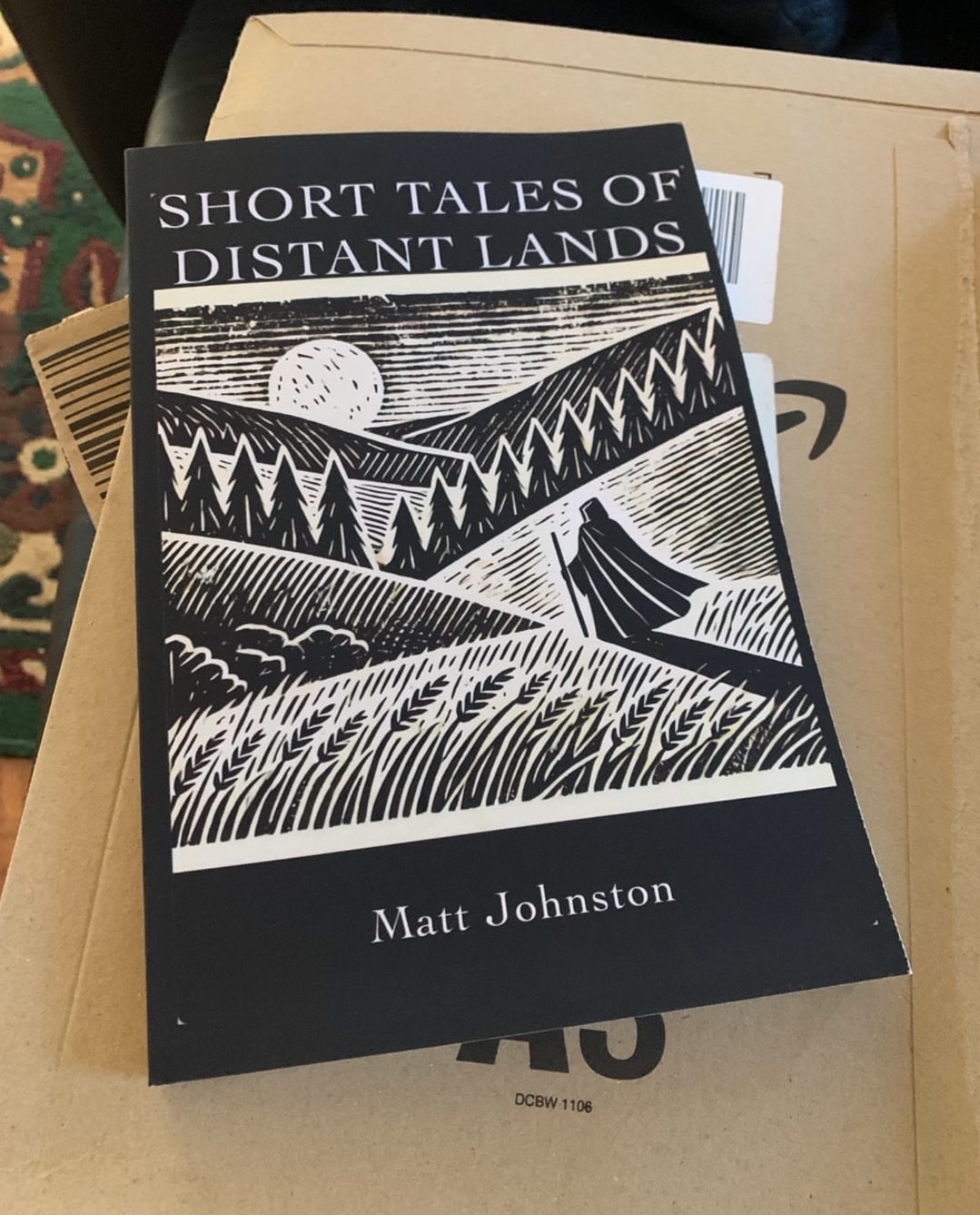
What’s going on?

It’s been a busy start to the year.

I started working on a novel at the end of the summer of 2024 and finished it just before Xmas. It’s currently with a group of close friends for an initial read-through before I take it further. In the meantime I cadged together a heap of short stories and published them on Amazon as “Short Tales of Distant Lands” and I’ve been beavering through a new anthology of short stories called “A Whole New World”. That and pulling together the outline for Book 2 of the Tales of Distant Lands series.

It’s all about the writing at the moment. I’m feeling all of the stress too.

Wish me luck as I endeavour to find an agent, find a publisher and if that doesn’t work….well….I’ll self-publish.

Wear and Tear

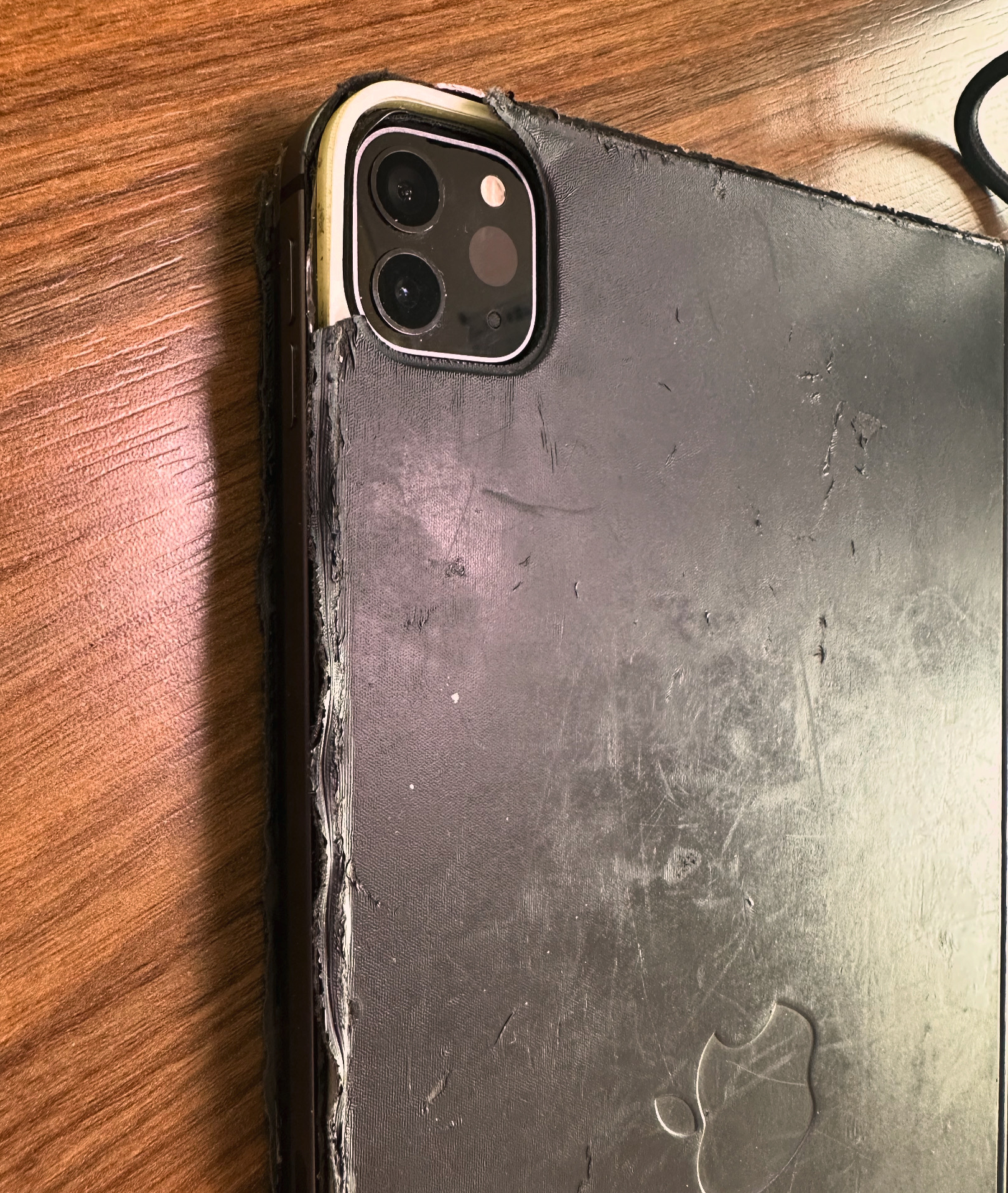
I’ve been using this Magic Keyboard for 3 years now. Around the same amount of time as this iPad Pro. And I have to say it’s served me well.

The Magic Keyboard mat be expensive but it provides one thing above and beyond a really nice backlit keyboard and nice trackpad, it provides the iPad Pro with an additional USB-C charging port, freeing the built-in port for external peripherals like hard drives.

Now, it’s not pretty. And if I met Tim Cook, I’d probably mention that these hardware peripherals in this soft plastic covering are not particularly durable or eco-friendly. I compare this to other materials which seem to be better with age.

But, other than that appearance, it’s functional. A better keyboard than the MacBook 12″. And the flexibility of the iPad with Magic Keyboard is hard to beat.

A quick Google sees that I’m not alone in this. I wonder if there’s a way to seal up these tatty edges or have it re-bound?

The Hardest Journey

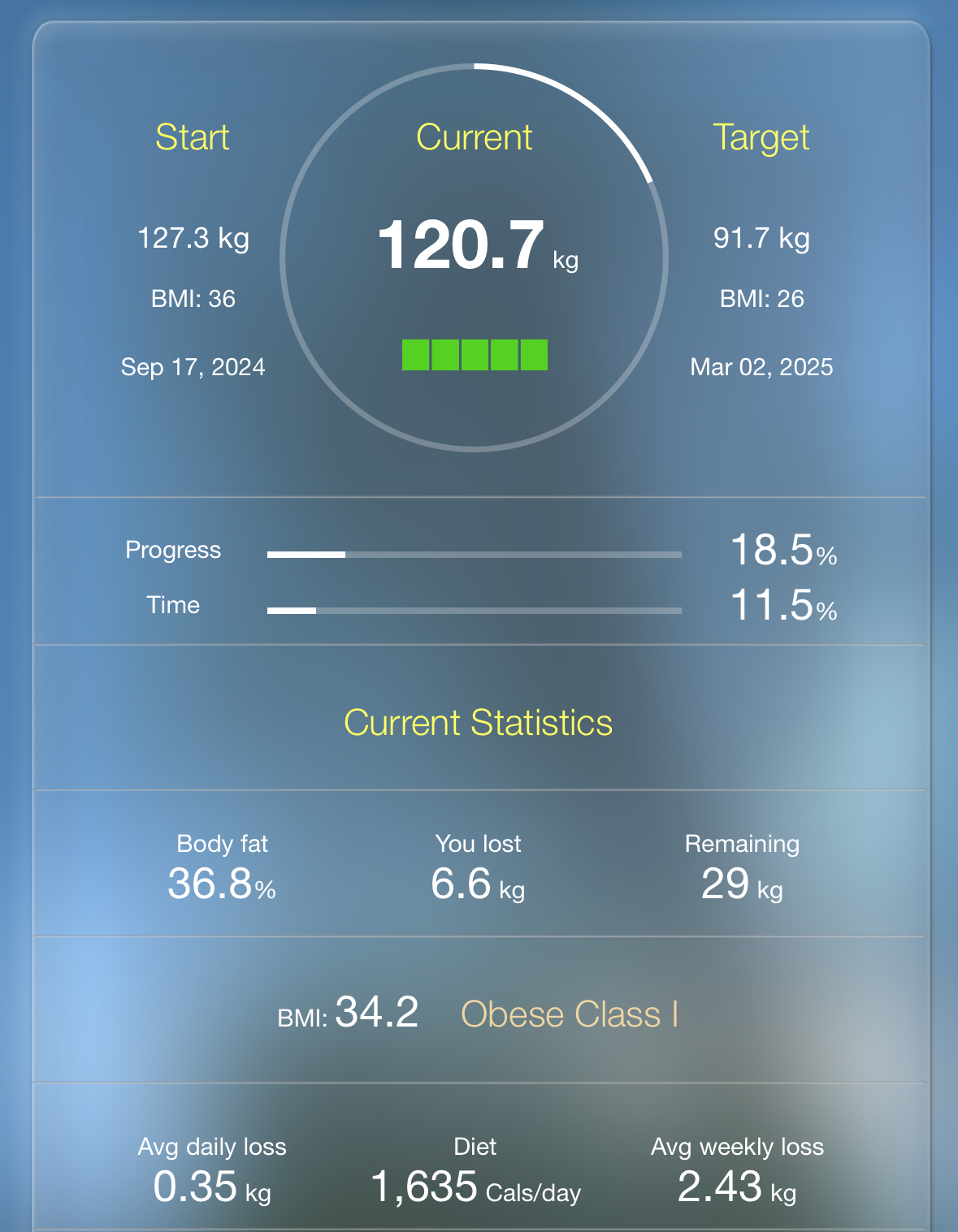
A combination of age (sedentary work) and too much good food has left me heavier than I’d like plus acutely aware of the intra-abdominal fatty deposits so I’m back on the diet that worked well enough just under a decade ago.

My aim is to be lighter than I’ve been since, well, forever.

That’s a 30 kilogram loss. One quarter of my body weight.

I started on the 17th of September by just reducing my calorific intake and I’m getting good results. My issue has always been portion sizes and, for whatever reason, not having a reliable “I’m full now” response.

My previous weight apparently required a 2500 cal a day intake to maintain so I was definitely overeating. I’m now on an 1800 cal diet. Dropping my intake by a quarter will definitely make a difference.

Having a calorie limit does help. Sometimes I’m a couple of hundred cals over, sometimes I’m a hundred cals under.

I see the difference on the scales but I haven’t seen it on the clothes or in the mirror yet.

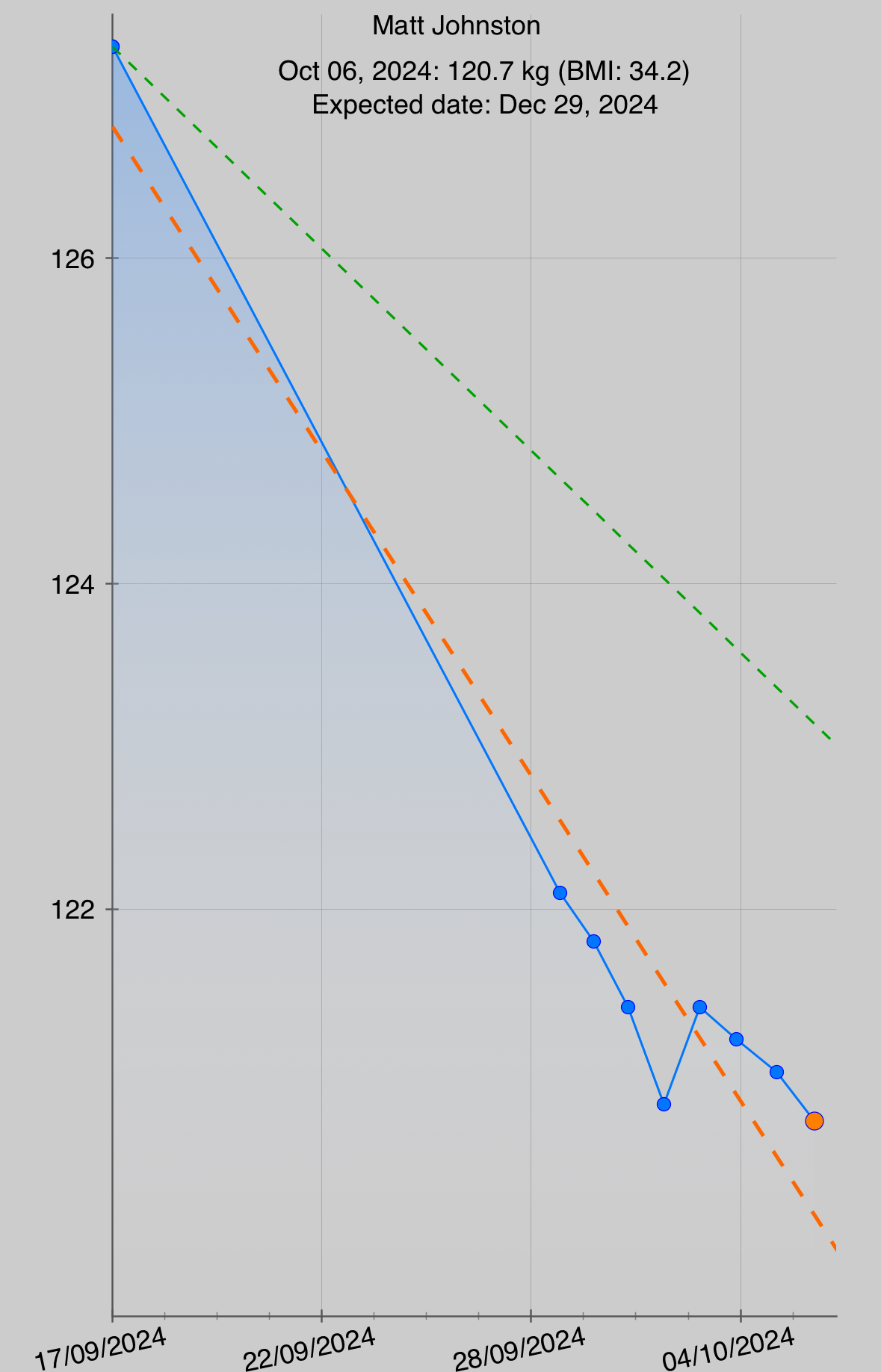
Since the 17th Sept I’ve dropped 6kg. That’s pretty good. I know it will plateau.

Did the EU force Apple to adopt USB-C?

In 2022, a law was passed by the European Parliament that required all manufacturers of certain types of consumer electronics to switch to the USB-C connector.

Apple, though not alone, was opposed to this. You don’t hear about who else was opposed because, well, no-one cares. Journalists love a good Apple story as it drives clicks.

So, let’s rewind. USB-C is a 24 pin reversible connector that was designed to replace all other USB connectors. Why? Because prior to USB-C the standard was a mess.

You had devices that used USB-A, USB-B, mini-USB, micro-USB, and others.

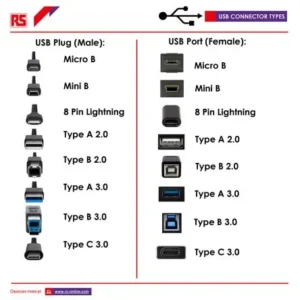
USB plugs courtesy of RS Components

The diagram above shows the state of the market and that diagram isn’t even complete as it misses out the USB 3.0 micro-B connector and plug. Anyone who’s ever had to plug in a USB cord in the dark or behind a printer will understand. And for micro USB it’s trivial to damage the port.

The main advantages of USB-C are in the protocols, in power delivery and the fact it doesn’t matter which way you plug it in. (Which would only be improved by making it round).

USB-C is superior because it crams a lot in there but it’s really the quality of the cable and the protocols it uses which make the difference. Not all USB-C ports and connectors and cables are the same. Some mobiles have USB charging ports which don’t support DisplayPort or even USB Mass Storage. Some support Thunderbolt 2 or 3. Some won’t support USB 4.

So, in 2018, the EU did a study. They found around half of chargers sold with mobile phones had a micro USB port, 29% had the newish USB C port, and 21% used Lightning. The micro USB port and connector were terrible. They were fragile, had to be plugged in one way and alignment was very important.

In contrast the Lightning connector was small, could be plugged in either way and supported USB 2.0 (and USB 3.0). The plug itself was over engineered with a microprocessor inside each plug head. It supported displays, audio and mass storage formats. But it wasn’t a standard and it belonged to Apple so there were going to be haters.

In 2019, the EU decided to pick the USB-C standard for charging small devices. Apple argued against this and a lot of people think it was because they earned royalties on Lightning – which is certainly true under their MFI programme but it’s also certainly true that the vast majority of Lightning accessories never paid a cent having been produced by reverse engineering and available for a pound (or Euro or Dollar) in cheap shops.

By 2019, Apple had already transitioned more than half of their product line to USB-C, starting with Macs in 2015 and then starting with iPads (replacing Lightning) in 2018 with the release of the iPad Pro 3rd Gen. This was in spite of Lightning supporting the USB 3.0 protocol – Apple wanted to move to a new cable. Remember, when Lightning was introduced in 2012, it was replacing the 30-pin connector and this was two years before the USB-C specification had even been produced.

So, before the EU had even held their study, Apple had already started replacing Lightning with USB-C on their mobile devices. Remember if the iPad Pro went USB-C in 2018, the plan for that was probably even before that (if any consideration to supply chains is given).

As mentioned, Apple and other manufacturers oppose the law but it wasn’t to get those tasty licensing fees from Lightning connectors. Anyone who thinks Apple built a trillion dollar company on Lightning licensing fees is a buffoon. It was about what comes after USB-C.

After USB-C? Sure. You think the USB-C connector is the optimum? Oh no. There will be other superior connectors, there are other superior connectors.

One thing is for certain, the EU is like any other political organisation and they get lobbied. There’s a heap of people who think that politics should stay out of business (mostly Americans who don’t know what they’re talking about) and a few more who think politics should stay out of technology development (mostly technologists who do know what they’re talking about). One thing is certain, politicians generally don’t know what they’re talking about.

Don’t get me wrong – I am a fan of the EU. I applaud when they intervene on public health issues or poverty issues or workers rights issues. Bravo. I’m not so sure they should weigh in on charging cords. (And the Digital Markets Act is a mess).

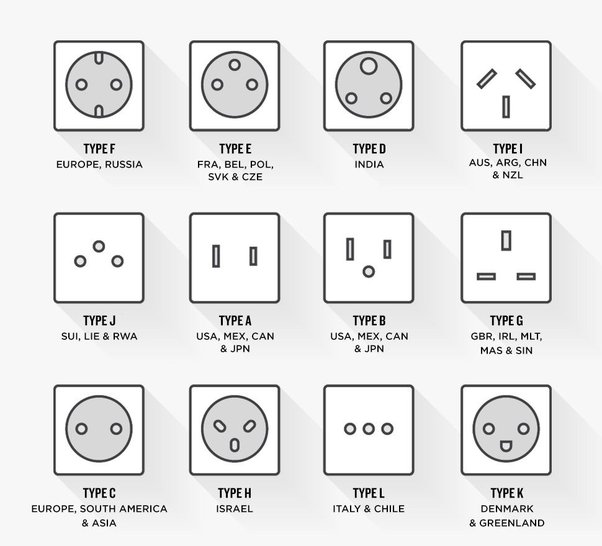
I mean, it seems a little hypocritical that there are multiple types of wall plug in the EU, right? And the EU is utterly silent on this.

So, the EU passes the law in 2022 with a deadline of late 2024 for compliance. That’s to let companies make new plans, sell down stock, change supply chains, transition technology. Apple, as we have seen, is well on the way to transitioning their entire product line. They have the behemoth of the iPhone to consider but they successfully transition it in 2023, a full year before the deadline.

The problem is that the law is prescriptive and affects what happens in … say 2035 when we need a better port for charging or data transfer or whatever. The EU will have to ruminate on repealing the USB-C law or updating it. They’re not great at that – other priorities.

So when the USB consortium comes out with USB-X (for example), everyone can start charging to it, except for the EU market. They have to wait for the law to be changed to allow USB-X. It took 8 years after the introduction of the USB-C standard for the EU to create the USB-C law. So the argument is that this will artificially delay the development and introduction of new technology in the EU. And they’re right.

We elect politicians on their how much we like them – sure their policies can matter (though certainly less at the EU level) but it’s heavily based on whether we like them or who or what they are. (Just look at the narratives emerging around U.S. Democratic nominee Kamala Harris from people who really don’t like the idea of a woman, particularly a woman of colour, as President. Meanwhile in the U.K., they had a blow up doll, a pompom, a weasel and a thief as Prime Minister before the recent election of the new Centrist Labour Guy).

We don’t elect politicians based on what they know. We trust they will find smart advisors, listen to lobbies on good stuff and resist lobbies on bad stuff. It is frankly amazing we have survived so long.

That’s why I don’t think that the European Parliament was qualified to dictate USB-C and maybe a more delicately worded law could have been drafted which wouldn’t stifle the future market. Remember it isn’t all about standards, look at the diagrams here. These are, for the most part, standards. And there are a lot of them. And if you really want to curl your toes, check out the standards for the USB protocols. Then query whether your USB-C cable meets all of them. (I doubt it will).

Anyway. I’m tired of the narrative that Apple was forced into adopting USB-C. If this was the case why did they start transitioning across their product line 3 years before the EU even performed the study and 7 years before the law was ratified. Because it was on their roadmap.

The question is what happens when the new standards arise.

Timeline below of when Apple went USB-C

USB-C spec published Aug 2014
12” MacBook: Apr 2015
Touch Bar MB Pro: Oct 2016
iMac in 2017
Mac mini 2018
MacBook Air in 2018
EU study on phone connectors 2018
iPad Pro in Nov 2018
Mac Pro in 2019
EU study results released 2019
iPad Air 4: Oct 2020
iPad mini 6: Sept 2021
EU law passes 2022
iPhone 15 in 2023
EU deadline: late 2024

Digging out the Pi again.

This morning as I was running early for meetings, I dug out my old Raspberry Pi devices that I have sitting in a drawer. I’m not entirely sure if I have a 2 and a 3 or a 3 and a 4, but I think I’ll boot them later and check.

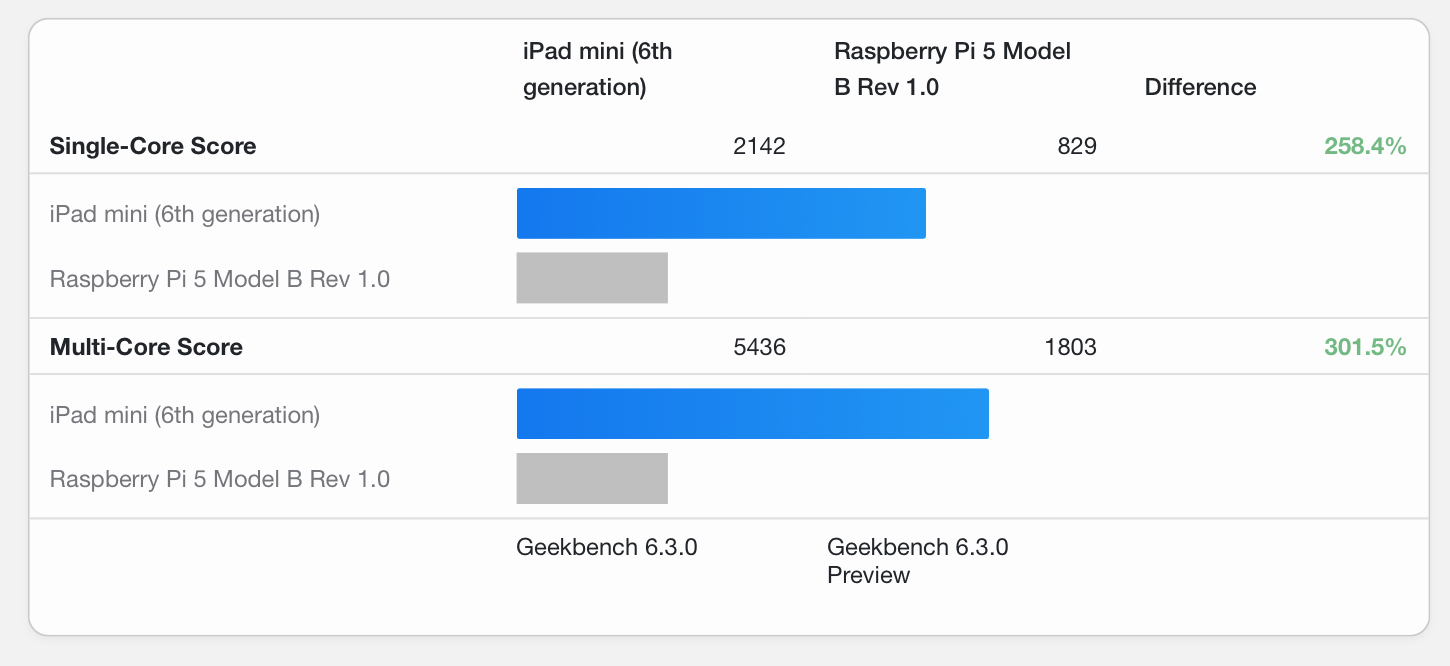
I was thinking about a Pi 5 because, well, it’s been a whole lifetime since I even booted them. So, with the money burning in my pocket I decided to check them out. Same hardware design (yes, I know it’s slightly different – heavy use of USB-A ports and only one USB-C used for Power.

What about performance. Oh. Dear God.

Yeah, that can wait.

It might be twice as fast as a Pi 4, but honestly I’ve got much more performant hardware lying around. So what would I be using the Pi for?
It’s for the one thing that is kinda missing on the iPad – terminal commands. I can get away with SSH to my server using one of the many ssh programs I’ve got on the iPad but it seems wasteful sending commands to a data centre thousands of kilometres away when I really want to mess with files that are sitting on a disk right beside me.

It can all wait. Maybe the Pi 7….

Today I launch my writing Patreon

I realise it’s been a while since I updated this.

Moneys gained will be for the production of art and promotion of the roleplaying game and novel I plan to write. I will be posting snippets of both over there,